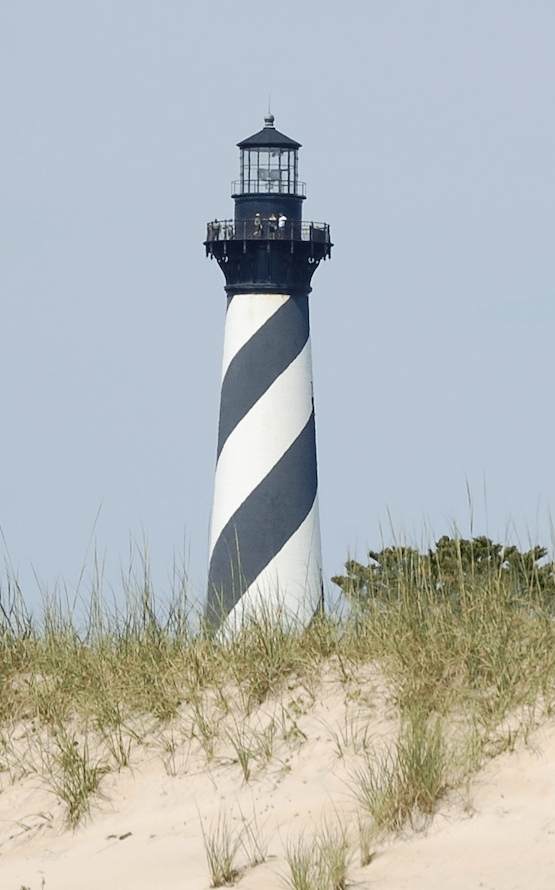

Standing sentinel over North Carolina’s treacherous coastline, the Cape Hatteras Lighthouse has witnessed centuries of maritime drama, human tragedy, and according to many, accumulated more than its fair share of supernatural residents. At over 200 feet tall and requiring more than a million bricks in its construction, this iconic black and white spiral-striped beacon has become not just the tallest brick lighthouse in North America, but also one of its most haunted.
A History Written in Brick and Mortar
The story of Cape Hatteras Lighthouse begins in 1797, when Congress allocated $44,000 for its initial construction. However, the structure we see today dates to 1870, built to replace its predecessor which had fallen victim to both shoddy construction and alleged Civil War damage. The lighthouse’s distinctive spiral pattern wasn’t even intentional – it resulted from an engineer’s misinterpretation of the original diamond pattern plans, creating what would become one of America’s most recognizable lighthouses.
In a testament to human ingenuity and determination to preserve history, the entire lighthouse was relocated in 1999. Over 23 painstaking days, the massive structure was moved 2,900 feet inland to protect it from the encroaching shoreline. Remarkably, it seems the lighthouse’s ghostly inhabitants made the move as well.
The Ghost Ship That Never Sailed Away
Perhaps the most chilling tale associated with Cape Hatteras is the mysterious fate of the Carroll A. Deering. On January 31, 1921, this five-masted schooner was discovered run aground on the treacherous Diamond Shoals, with a scene that could have been pulled from a maritime thriller. The ship was found completely abandoned, save for a few hungry cats, with dinner still laid out on the table as if the crew had simply vanished mid-meal. The lifeboats were missing, but otherwise, the vessel was in perfect working order – even the sails remained unfurled.
The disappearance prompted an FBI investigation and caught the attention of then-Secretary of Commerce Herbert Hoover, especially after it was revealed that nine other ships had vanished in the same area. While theories ranged from piracy to rum-runners to mutiny, none could fully explain the eerily abandoned vessel. Today, visitors report hearing desperate screams near the shore, with some witnesses claiming to hear a man repeatedly crying out about “a monster coming for him.”
The Guardians of the Shore
The lighthouse’s spectral residents seem to be as diverse as the ships that once passed its beam. The most famous is the Gray Man, a benevolent spirit who appears to warn locals of approaching hurricanes. Legend holds that those who heed his warnings find their homes spared from storm damage. He’s sometimes accompanied by a phantom brown pelican, also said to appear before major storms.
A more unsettling presence is the Dark Lady, described as a woman of Spanish descent dressed in black, her clothes perpetually dripping with seawater. She’s often seen walking the shoreline on full moon nights, her angry wails echoing across the beach as she searches endlessly for something lost to the sea.
Modern Hauntings
Today’s visitors report numerous paranormal encounters, from the lighthouse’s resident ghost cat – a large black and white feline that’s been spotted for over a century – to more sinister shadow figures that lurk on the lighthouse stairs. These shadow people, as paranormal researchers call them, are particularly intriguing as they’re believed to be drawn to areas of great trauma and emotional intensity.
Perhaps the most heart-wrenching of all the lighthouse’s ghostly residents is the Crying Child. Visitors walking near the lighthouse at dusk often report hearing the mournful sobbing of a child, the sound carrying clearly on the sea breeze. The cries are said to be those of a young soul lost to the treacherous waters that gave this area its ominous nickname: the Graveyard of the Atlantic.
A Legacy of Mystery
The Cape Hatteras Lighthouse stands as more than just a navigation aid or historic landmark. It serves as a silent witness to countless maritime tragedies and, if the stories are to be believed, a gathering place for spirits unable or unwilling to leave these shores. Whether drawn by the lighthouse’s powerful beacon or bound to the waters that claimed their lives, these spectral residents have become as much a part of Cape Hatteras as the shifting sands and crashing waves.
The lighthouse’s 257 steps still invite visitors to climb to its top, though some report feeling unseen presences on their journey upward. Perhaps it’s just the wind whistling through the structure’s iron stairs, or maybe, as many believe, it’s the lighthouse’s ghostly residents, still keeping watch over the treacherous waters they once called home.
Works Cited
Ambrose, K. (2011). Ghosthunting North Carolina (1st ed.). Clerisy Press.
Foster, G. W., II. (2024). True ghost stories of North Carolina: Real and true hauntings and spooky stories of the Old North State (1st ed.). Reedsy.
North Carolina Haunted Houses. (n.d.). Cape Hatteras Lighthouse. Retrieved from https://www.northcarolinahauntedhouses.com/real-haunt/cape-hatteras-lighthouse.html
Only In Your State. (n.d.). The haunted Cape Hatteras Lighthouse in North Carolina. Retrieved from https://www.onlyinyourstate.com/experiences/usa/cape-hatteras-lighthouse-nc-haunted-usa
Visit NC. (n.d.). Haunted places in North Carolina. Retrieved from https://www.visitnc.com/story/xZiP/haunted-places-in-north-carolina

 ENCYCLOPEDIA STRANGE
Leave a comment